· Amine Jalili
Where Do European Fashion Brands Actually Manufacture Their Clothing?
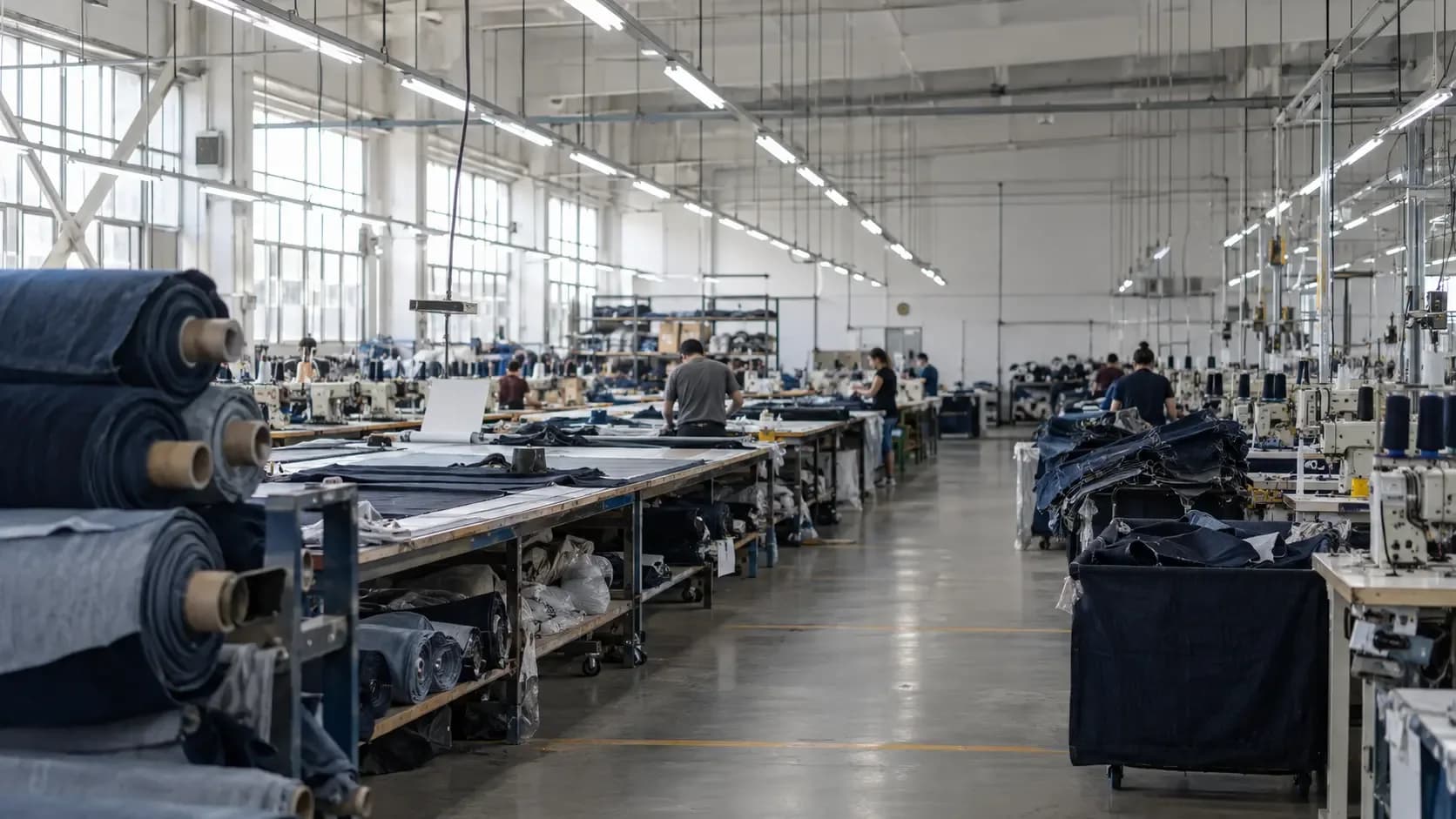
A 2,000-piece carryover order and a 120-piece capsule collection can end up needing two completely different supply chains, even from the same brand, in the same season.
That's the real starting point, and it's why "which country is best for manufacturing clothing" is the wrong question. Brands don't choose a country because it's universally best. Order volume, reaction speed, product type, origin and duty requirements, flexibility, price structure, and what a specific factory can actually deliver decide it. A country's reputation doesn't.
Some of what follows is genuinely fixed at the country level: trade agreements, EU membership, geography, rules of origin. Most of it isn't. MOQ, lead time, price, and quality vary enormously within every country here, including the one we're part of. Keeping those two categories separate is the point of this piece.
Two different kinds of fact
Set by the country, roughly fixed: EU membership status, the customs or trade-agreement framework, geographic distance from your market, rules-of-origin conditions, the general depth of the manufacturing ecosystem.
Set by whoever you actually work with: minimum order quantity, lead time, price, sample-development speed, quality consistency, communication, current capacity, certifications, specific product expertise.
No country has "a" price or "an" MOQ. It has a range, set factory by factory.
Asia
Several Asian manufacturing regions (parts of China, Bangladesh, Vietnam, India among others) have built ecosystems at a scale most other regions haven't matched: fabric mills, trims, dyeing, and finishing all present at real depth. It's the long-standing default for high-volume European retail, for a straightforward reason: ecosystem depth supports very large, stable-demand production runs that smaller regional supply chains can't easily match.
The distance cuts the other way. Freight time from Asia is a real factor by geography alone, measured in weeks by sea rather than days. Time-zone and communication gaps can slow sample iteration and corrections. And ethical or compliance due diligence varies enormously by factory and region, which means it needs real vetting rather than an assumption based on the country.
What none of that tells you: unit cost, MOQ, lead time, and quality are set by the specific factory and program. "Asia" is not a pricing category. A large, stable-demand program, core replenishment styles, basics, ordered well ahead of the selling season, is where Asia's advantages tend to actually apply. A brand needing to react mid-season usually finds them cancelled out by the distance.
Portugal
For a brand where EU-origin manufacturing is a requirement rather than a preference, EU membership itself is the reason Portugal enters the conversation. That's a structural fact of the internal market, not a marketing claim. The country also has a long-established textile and clothing industry with its own dedicated trade association (ATP) and decades of experience serving Western European fashion brands.
That EU membership comes with EU-level costs. Labor and operating costs in Portugal generally sit above non-EU nearshore options, though the actual price gap for any specific order still depends on the factory and product rather than a fixed national rate. And the precise legal basis for a "Made in Portugal" or "Made in EU" claim on a label depends on where manufacturing and finishing genuinely take place, independent of EU membership alone.
As with every geography here, MOQ, price, lead time, and specialization vary by factory. Portugal runs from small ateliers to large industrial operations, and no single number describes "Portugal's price." Where it's worth a real look: when EU-origin manufacturing is a genuine requirement, whether that's a retail partner's condition, a labeling claim, or a brand story built around it.
Turkey
Turkey's relationship with the EU rests on a Customs Union in force since January 1996, covering industrial goods, textiles and apparel included, moving duty-free between the two. The A.TR movement certificate used under this framework proves a good's customs status: that it's in free circulation within the EU-Turkey Customs Union. That's a different mechanism from preferential origin, which is what EUR.1 certificates establish for Tunisia and Morocco below. Goods can qualify for duty-free Customs Union treatment without the same kind of origin-of-materials proof those agreements require.
Turkey has also built one of the largest, most vertically integrated textile and apparel manufacturing bases outside Asia. The scale shows up in who uses it: per Inditex's own annual reporting, Turkey's share of its total factory count reached 23% in its most recent disclosed year, overtaking Spain as Inditex's single largest nearshore sourcing market.
None of that guarantees a smaller brand gets real attention. How much priority an order gets varies enormously between a factory built for high-volume fast-fashion replenishment and a smaller specialist workshop. "Turkey" describes an ecosystem, and an ecosystem holds many different operating models inside it. It's worth investigating when a brand needs genuine production scale and speed together, at an order size large enough to matter to an established factory.
Tunisia
Here's the disclosure: this is us. Read this section the way you'd read a competitor's: check the claims, not the tone.
Tunisia was the first of the EU's Southern Neighbourhood partners to sign and implement an Association Agreement, in place since 1998. Under the Pan-Euro-Mediterranean rules of origin, garments manufactured in Tunisia can qualify for reduced or zero EU import duty, evidenced by a EUR.1 movement certificate, provided those origin rules are actually met for the specific product. The European Commission describes this plainly as conditional, not automatic: to qualify for the preferential rate, a product needs to comply with specific rules that prove its origin.
What that framework doesn't tell you is anything about a given factory. Our own minimum order quantity is 50 pieces per style, a fact about us specifically, not a Tunisia-wide standard. Other manufacturers, here and elsewhere, run higher or lower depending on the factory and program, same as everywhere else in this piece. Denim specifically, our founding specialty, is where our own base has real depth. That's a claim about us, not a blanket statement about every Tunisian manufacturer.
This is worth investigating for a brand producing denim, casualwear, or workwear, at a volume that doesn't require the largest-scale ecosystems, where EU-trade-agreement-backed nearshore production genuinely matters to the decision.
Morocco
Morocco's Association Agreement with the EU has been in force since March 2000, providing 0% duty on industrial goods, apparel included, under the same kind of Pan-Euro-Med cumulation rules as Tunisia's, conditional on meeting origin requirements. Geography does real work here: Morocco sits across the Strait of Gibraltar from Spain, close enough that it's become a genuine option for fast-turnaround production serving that market specifically.
In Inditex's own factory-location disclosures, the EU, non-EU Europe, and Africa (led by Morocco) together accounted for just under 38% of its total factory count in its most recent reported year, part of a broader mix that shifted further toward Asia year-on-year, by the same disclosure.
The rules-of-origin picture here is genuinely current. Protocol 4 to the EU-Morocco agreement was amended by Decision 1/2025 of the Association Council, in force since 2 October 2025, and now tracks the evolving Pan-Euro-Mediterranean Convention text directly, with transitional provisions running until 31 December 2027. The exact effect on a specific textile finishing or processing requirement sits in an annex tied to product category. It's worth confirming current terms directly rather than assuming an older sourcing guide still applies.
As with every geography above: price, MOQ, lead time, and quality are set at the factory level. This is worth a look for a brand whose priority is fast replenishment for trend-sensitive product, manufactured close enough to reach Southern Europe quickly, where the current rules-of-origin terms are workable for the fabric you're sourcing.
A practical checklist, before you compare countries at all
This predicts a good sourcing decision better than any country ranking does. Before weighing geographies against each other, you should be able to answer:
- Target retail price and allowable manufacturing cost
- Order quantity, and how firm it is
- Repeat-order needs: can you reorder mid-season, or is this a single production event?
- Sample-development requirements: how many rounds, how fast?
- Product complexity: washes, trims, technical construction, and multi-fabric builds all narrow your options differently than a jersey tee
- Material sourcing: where does fabric come from, and does that affect origin qualification?
- Reaction speed you actually need: genuinely, not aspirationally
- Origin and duty implications: does preferential access apply to your specific product and materials?
- Required certifications: what does your retail partner or your own compliance standard actually require, and can the factory evidence it?
- QC process: what's inspected, when, and by whom?
- Communication cadence: how often, in what language?
- Freight model: air, sea, or road, and what that does to landed cost and timeline
Answer those first. The country-level facts above will usually narrow your list on their own, and the factory-level facts decide the rest.
Where this leaves you
The shortlist starts with geography. The final decision is still a factory decision. That's why two brands can source from the same country and come away with completely different experiences of it.
If Tunisia fits the checklist above, BIG DJINS:0 operates within that option as a Tunisian nearshore manufacturing partner focused on denim, casualwear, and workwear for European brands, with an approach built around flexibility, quality control, and transparent production.
Its minimum order quantity of 50 pieces per style is one practical detail to consider when evaluating whether the factory fits your program, rather than the reason to choose a production partner.
For a closer look at the sourcing trade-offs, read our Portugal, Turkey and Tunisia manufacturing comparison.